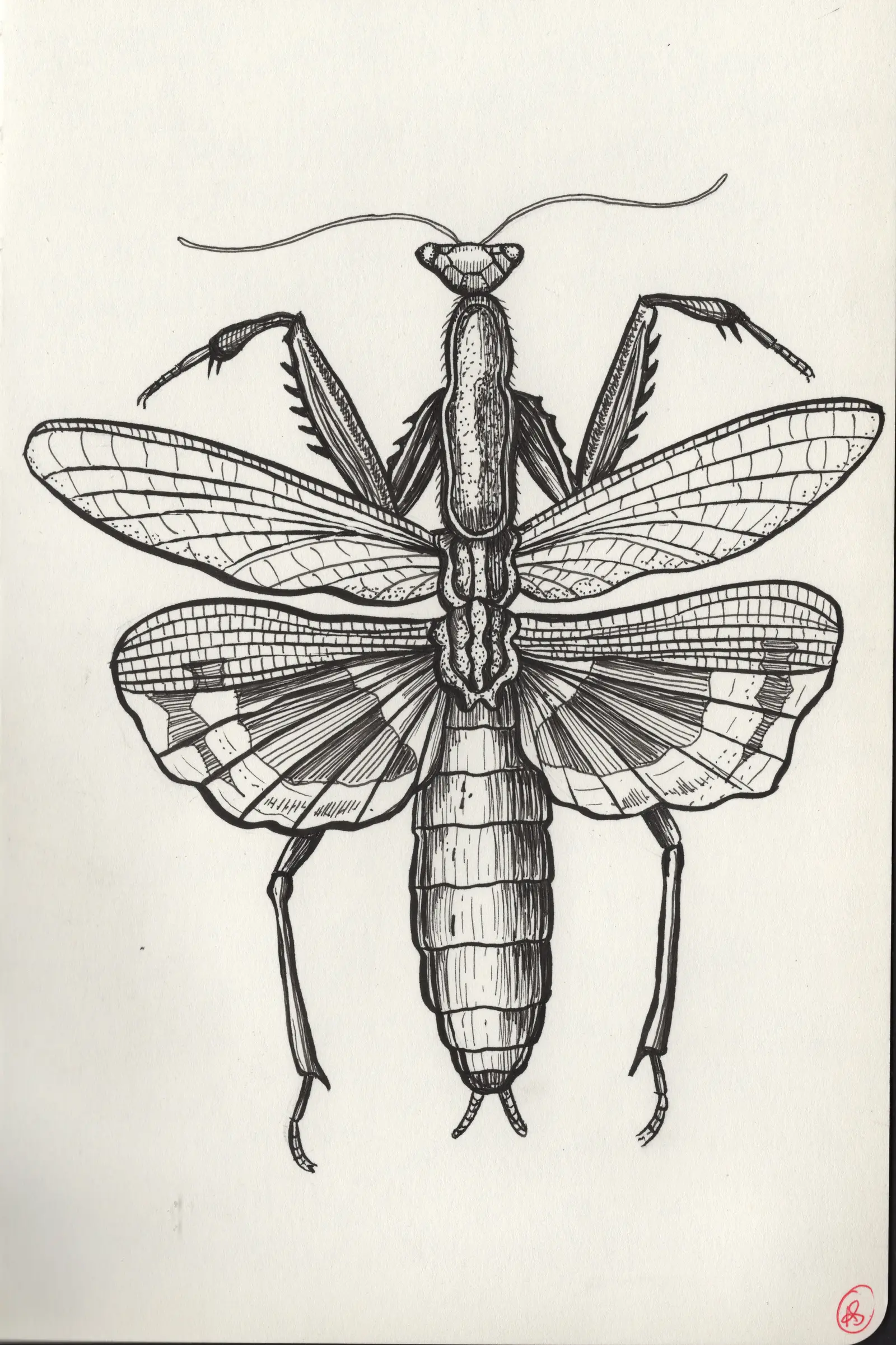
This personal project was a response to taking a step away from the screen and reentering into consistent practice in analog format, combined with setting a personal goal of creation for the sake of it without a specific audience or timeline or budget. The simple act of turning an observation into something anew on paper. The process reintroduced a creative practice of perceived mistakes that turn into happy destinies, that wings are built and never break, and there is no better designer than nature.
Illustration

The brief
HBR is seeking to produce a short animated infographic for the article “Building Healthy Habits When You’re Truly Exhausted” written by Author Elizabeth Grace Saunders to be featured on their YouTube channel.
The goal is to make the messages in
the article clearly communicated and also appeal to their primary audience.

visual cues
The constraints of using ink on paper is the constant need to give in and allow the brush pen and permanency to take over. Unlike digital tools with command + z this method allowed for no take backs or re-dos. A prerequisite and requirement to lean in.
The morphing ability and transient nature of insects brought a lot of peace during this series, hovering on the wondering and white space of what it'd be like to have armour that is shed to reveal a new body.
“Look closely at nature. Every species is a masterpiece, exquisitely adapted to its environment.” — E. O. Wilson
Insect eyes and human eyes are anatomically distinct, each adapted to their specific needs and environments. Insects have compound eyes made up of many small units called ommatidia, each with its own lens and photoreceptor cells that together create a mosaic form of vision. Each ommatidium captures a small portion of the insect’s field of view, allowing for wide-angle vision that is especially sensitive to motion. Humans, by contrast, have a single-lens eye with a complex structure that includes the cornea, iris, lens, and retina. The iris regulates the amount of light entering through the pupil, while the lens focuses light onto the retina, where photoreceptor cells known as rods and cones process visual information.
This hand-drawn linework style insect illustration sparked a creative rainbow road down towards oceanic creatures and has directing to future series ideas.